The Maasi Mara

June 14 - 17

The Maasai Mara is the holy grail of Kenyan safari. The Mara as it’s called, is the northern half of iconic grasslands that stretch across southern Kenya and northern Tanzania, encompassing almost 13,000 sq miles. It Tanzania, this savanna is called the Serengeti. It is home to an astounding 95 mammal species and 550 types of birds.
Our safari took us to the Mara North Conservancy which is a beautiful private wilderness area of more than 73,000 acres. It is a vital part of the Maasai Mara ecosystem as it forms the north-western zone, bordering the Maasai Mara National Reserve in the south of Kenya. Mara North Conservancy is a not-for-profit entity established in January 2009.
Mara North Conservancy (MNC) is founded upon a partnership between 12 Tourism Partner members (6 camps, 3 lodges, and 3 riding outfits) and over 1000 Maasai Community Landowners. Mara North leases land parcels from individual Maasai landowners to form the Conservancy. Conservancy fees are collected by member Tourism Partners and forwarded to the conservancy to support the monthly Maasai Landowner’s lease payments and professional land management. This marks the first time the Maasai landowners have received substantial and direct income from wildlife. Together, MNC and the Maasai community are implementing sound land management policies including, controlled grazing, holistic management practices, low volume and low impact tourism, and community land-use plans.

We flew from Aboseli back to Nairobi and switched planes for a hop to the Mara. That flight was on the largest plane we encountered on internal flights. It was a “giant” 37 seat, turbo prop, De Havilland Dash 8. There are 11 airstrips on the Mara. We landed at the Mara North Airstrip located in the MNC.

On safari, every second of everyday is an opportunity to view wildlife. The drive from the airstrip to the Karen Blizen Camp kicked off our Mara adventure in a BIG spotted cat kinda way!


The Karen Blizen Camp offered another luxurious camping experience. Gloriously, there was no Wi-Fi in the tents. It was available in the dining room and the River Lodge which offered up super comfy seating, a dart board and superb hippo view. The camp sits on a bend of the Mara River, offering guests fabulous wildlife sighting on the sandy bank across from the camp.

The River Lodge


The keys to our tent came with a small but rather loud bell. We were told to ring the bell if you needed assistance in your tent. Safari camps come with nearly every modern convenience, except for phones in your tents and any form of cell service. Aside from screaming at the tip of your lungs, that silly little bells is all you can do if you have an emergency, even if it involves a marauding hippo…. Thankfully we didn’t need to ring our bell.


The first evening game drive emphasised why this region is famous around the world for its diversity and numbers of wildlife. We were out for several hours it was too dark to capture some of the more unusual critters we came across. These included the Spring hare which is known as the African kangaroo. It really does look and hop just like a tiny wallaby! We also spotted an African hare, Gehet cat and a Egypian mongoose. (I didn’t get any decent pictures of these, but these are such interesting creatures, I pilfered pictures off the internet to show you.)
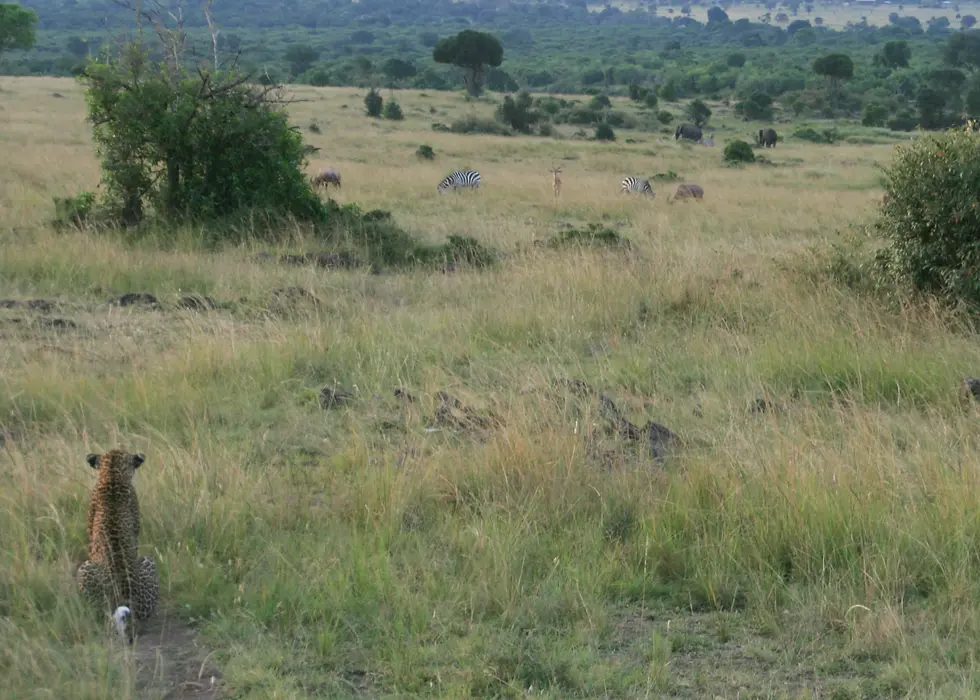
Before it got dark, we saw a leopard on the hunt. I’m not sure what he had for dinner that night, but it wasn’t a lucky gazelle.


We also encountered a group of hyenas gleaning the remaining scraps off a hippo carcass.


The following morning, we headed out on our morning drive and encountered this gorgeous male lion that was clearly on a mission. He moved a quick steady pace and was not remotely interested in us.

This big boy was headed to a feeding frenzy. An elephant had died of natural causes and had been claimed by his pride; this guy was late for breakfast!


The safari guides work closing with the rangers in the park, so our guide Joesph knew exactly where to find the dead elephant. We got there before him and got the witness his arrival and subservience to the dominate male of the pride. Throughout the rest of our stay, we checked the site every morning and evening. The pride dynamics were fascinating and watching how the different species interacted and waited their turn was incredible. Sometime on the second day, the park rangers came in and ran off the lions and removed the elephant tusks. I REALLY would have liked to have watched that process! This prevents the opportunity for poachers to take ivory and harm lions in the process. All ivory collected by rangers in Kenya is destroyed, so that it can’t end up in the illegal ivory trade.


We visited the carcass twice a day during stay. It was morbidly fascinating to see the "process". The biggest learning was that by day four, you REALLY want to be upwind of a decaying elephant...
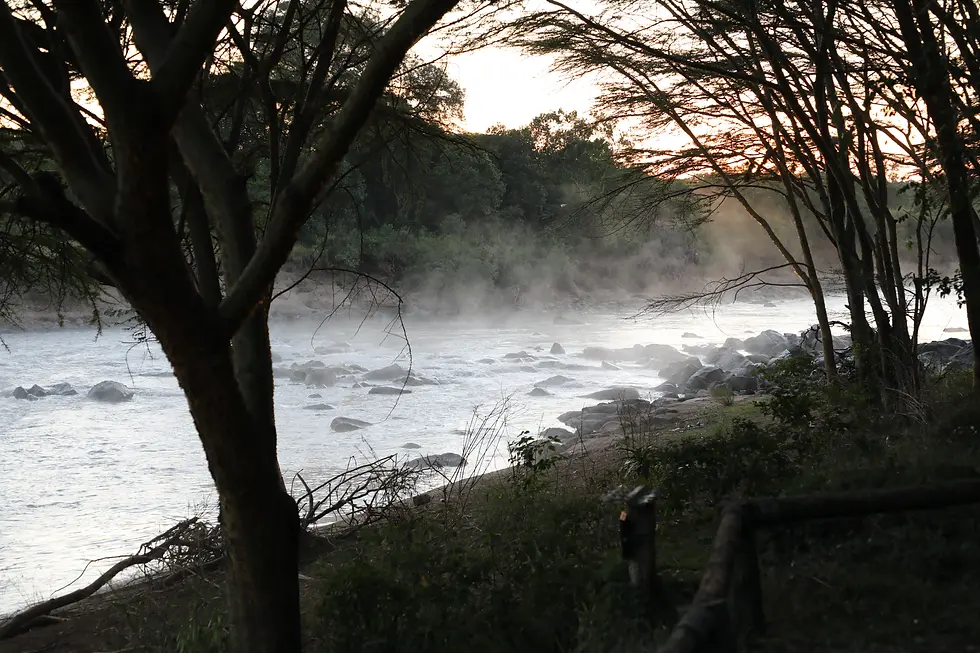
Mornings on safari come early. A 6:00 AM the cool morning air hanging over the Mara river makes for a gorgeous misty scene. There's tea and coffee along with some simple cookies/biscuits for guests to tide us over through the morning game drive. A fabulous breakfast to waiting for us on our return to camp.
This time of year the temperatures drop over night. The cool air over the warm river make for great morning photo ops.
After breakfast we strolled back to our tent to discover our deck inhabited by a group of vervet monkeys. I sent my fierce warrior husband in to shoe the monkeys away. I REALLY wish I had video or even pictures of this event. I was too busy watching the beady eyed buggers to think about taking pictures! The monkeys eventually left, but I don’t think he should add “professional monkey herder” to his resume…
Our days were spent in the River Lounge where a gentle breeze and sounds of the river and hippos provided an interesting soundtrack.



Most evenings on our way back to camp we encountered hippos grazing miles from the river. They will graze 6 to 8 miles away from the water at night. This is when hippos are most dangerous. Without water to where they can retreat, hippos simply destroy anything they deem as a threat. As our guide in Amboseli said, “Hippos are hateful herbivores that will tear you in half and leave you to the hyenas”. Despite the hippo alarm bell we were given, I was happy to believe that the retaining wall along the riverbank in front of the camp meant they couldn’t access the camp. Then Dave ruined my illusion when he pointed out these footprints.

One of the waitresses confirmed at hippos can and do wander through camp. Particularly during the wet season and the river level is higher. Then they can just swim up the dining room …. I was happier not knowing this....
On to a happier topic
The sun rises bathe the savanna is beautiful golden light. It makes taking beautiful photos quite easy.


It can also make some fun silhouettes...

Reasons to Laugh
There's a lot of awe and soaking in of majestic scenes, but there's plenty to laugh at too. One of the funniest moments in the Mara was when we were peacefully watching a family of elephants and beside our truck. They were so close, I had to switch from a zoom lens to wide angle.

What no one noticed was the youngster on the other side of the truck that decided to harass an egret with a very loud trumpet. Everyone, including our guide, nearly jumped out of our seats.

He was very proud of himself and the humans had a good laugh after a few seconds when we realized that we were safe.
Antelopes of all Sizes
African antelopes come is a wide variety of sizes. Unlike North American deer species which have antlers, antelopes have horns that do not drop each year. If a horn breaks it will not regrow and females will not breed with a male with a damaged horn. Aside from the dik dik, all the other gazelle species move and graze freely with other grazing species, i.e. zebras, giraffes, wart hogs, etc..
Dik dik
The smallest is the dik dik. Their name comes from the funny little noise they make, it's almost a clicking noise. They are tiny timid creatures, standing only about 15" tall at the shoulder and weigh less than 15 pounds. All other antelopes live in herds where one male fights off other males for control of the harem. Dik diks mate for life and live a solitary life with their mate. They are somewhat nocturnal. Dennis thought they were adorable until he was kept awake one night because a pair decided to spend the night around and under his tent "talking" to each other.

Impalas
Impalas live in gender specific herds. There is a rut season leading into breeding season where the males will fight for dominance and the right to breed the females. Adult impalas will reach 28-36 inches at the shoulder and weigh 90 - 150 pounds. Males are bigger than females and are the only ones to have horns.


Impalas are easily identified by these gracefully curved horns.
Grant's Gazelle
Grant's gazelles are a mid-sized antelope. They stand 30" to 37" at the shoulder. Males will weigh 100 to 180 pounds and females at about 75 to 100 pounds.


Thompson's Gazelle
Often referred to as a "tommys" ... or "cheetah snacks", Thompson's gazelles are one of the smaller gazelle species. They're only 24 - 28 inches tall and weigh about 45 - 75 pounds. Small size means that speed is their only defense. They are the fourth-fastest land animal, after the cheetah. The slow ones are the reason for their other nickname.


Topi
Topis are one of the lesser know members of the antelope family. They are larger than gazelles, standing 60 to 90 inches at the shoulder. Males can weigh up to 300 pounds. Both males and females have horns. One of their interesting habits is to use old termite mounds to keep watch for predators.

Waterbuck
Another lesser known species, the waterbuck has a couple of fascinating characteristics. They near drink water, the are able to meet their hydration needs solely by gazing, especially by morning dew covered grass. Their other fun party trick is that they secrete an oil that smells and tastes bad to lions. Once you are removed from the lion menu, life gets a whole lot easier on the savanna.


Wildebeest
Wildebeests are also known as Gnu. Swahili legend is that when the great creator was done making all other animals on the planet, he had some miscellaneous pieces left and he stuck them all together and make the wildebeest. They only have a few scattered stripes left over from the zebras on the front shoulders and a few on their sides. They have a beard like a goat and the horns like a hartbeest. The head of a water buffalo, the back of a hyena and the tale of a horse.

Elands
The largest of the species is the elands. These big buggers are the size of cow! An adult male is around 5.2 ft tall at the shoulder and bulls can weigh just over a ton. The typical range of 1,100–1,300 lb. Females are around 4.6 ft tall and weigh 750–981 lb. They can jump several feet in the air!


Comments